

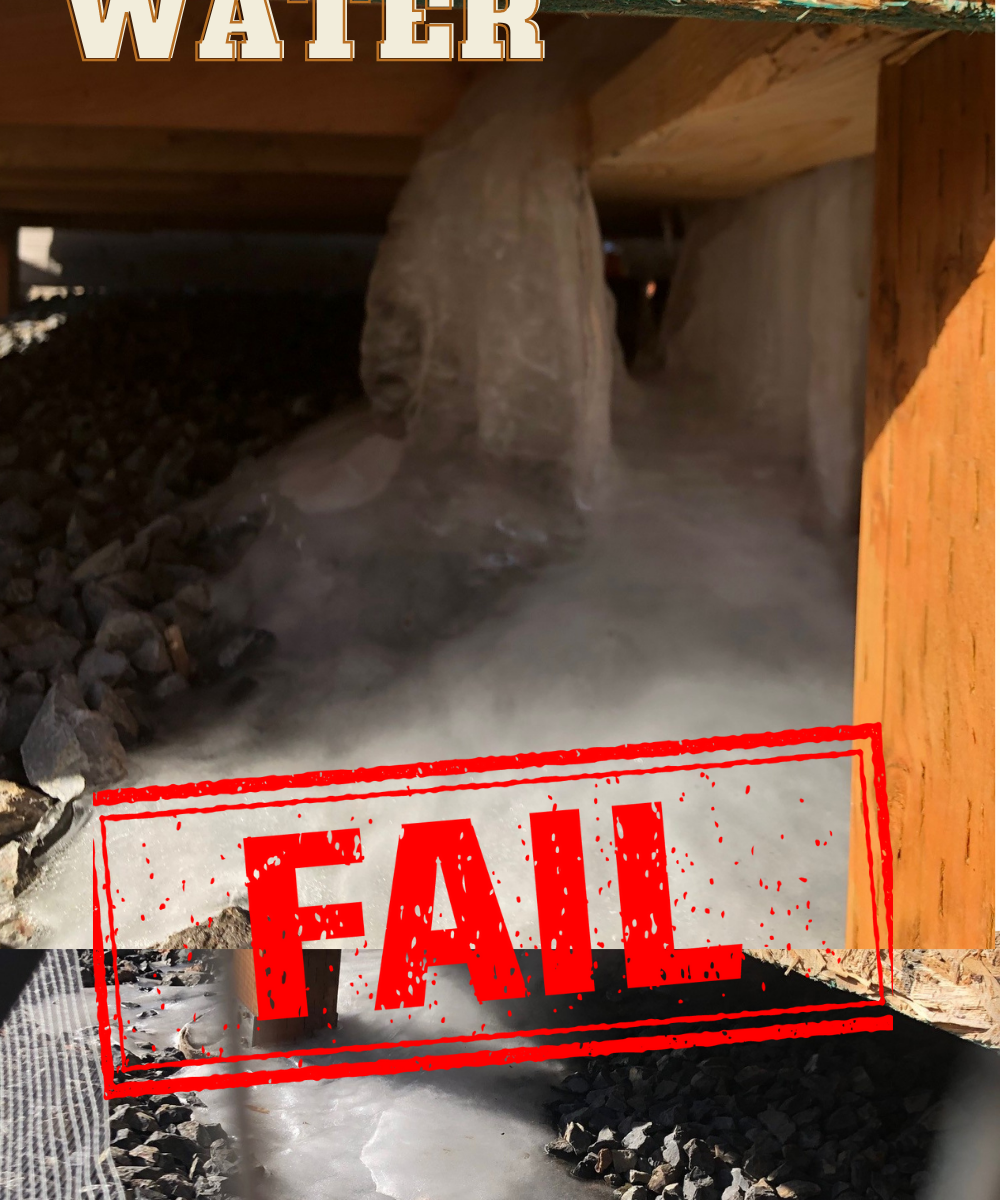
Ever have one of those moments where you’re basking in the glory of your own accomplishment and all of a sudden things begin to crumble right before your very eyes? Learning to homestead off grid provides these moments often. If life off grid was campfires and gardening all the time, this would be a very different blog – Or I’d probably just be playing in the garden rather than writing this. But the reality of living off the grid is that you have to design systems. And they have to work.
We recently had a hard rain followed by a cold snap which exposed design flaws (aka will cost us more money) in the electrical, plumbing and construction of our cabin. During the winter months we rely on a generator primarily for two things: first, to keep our battery bank charged up; and second, to run a small electric heater in our utility shed. The heater is a critical component because it keeps our entire water system from freezing. By entire water system, I mean the water tank, the in-line filter, the water pump, the water heater and the lines into the cabin are all housed in the utility shed.
So this torrential downpour occurs and water gets into the cord that connects the cabin to the generator. *Flaw #1: The power cord is not adequately shielded from rain.* Suddenly, the generator stops producing power. *Flaw #2: Failure to observe the law of one is none – we have no spare generator or power cord available* It is winter and the water lines will freeze without the help of the electric heater. Therefore, we have to shut down, and drain, the water system or risk losing the water pump and the water heater to freezing. Here is where the greatest design flaw and oversight in our system revealed itself – eventually.
Living in the middle of nowhere makes everything a multi-day project. So we shut off the water pump, drain the water heater, and purge the lines in the cabin so that nothing is damaged while we work on replacing the generator and getting a new power cord (these cords are harder to find than we assumed, and even with Amazon Prime, everything takes a week to ship here). The cold snap passed and everything began to thaw. After a week of limping by with no running water in the cabin we finally had a replacement generator and a new power cord. Eager to get the system back up and running, we open the door to the utility shed to find our half-full water tank is now empty! Yes, 125 gallons of water leaked all over the floor. *Oversight/Flaw #3: The water tank was not closed during the shut-down-the-water-system process*
It seems obvious, I know, but honestly it hadn’t occurred to us to shut the main valve on the tank. We focused on protecting the parts of our system that call for winterizing when not in use. Presumably that covered everything that could be damaged from freezing – with one exception: the in-line filter, which sits between the water tank and the water pump (diagram below). It’s a simple filter that screws onto a garden hose which we replace roughly every other month. Filled with water, that filter froze and cracked. Since the tank valve was open and the filter was cracked, nothing stopped all the water in our tank from leaking out onto the floor, then through it, and then freezing into an utterly destructive mess.

It is still winter, so we are currently waiting to clear out the entire utility room to assess the full damage. We believe we will have to replace the floor, at the very least. There are so many points along this narrative where better design could have spared us from suffering and additional cost. The problem is that we didn’t know what we didn’t know. And that is really the moral of this story. When you’re trying to build a functional off grid system you should absolutely aim for flawless design, but be ready for the flaws to reveal themselves in merciless fashion anyway.
The importance of having a spare (or two) of every critical component in your system cannot be overstated. I have learned to keep spare water pumps, even a spare water heater, but failing to have a spare generator when you live off grid – big time fail. On a positive note, we did properly winterize and drain the rest of the system, so with the water tank refilled and a new filter in place, we are back up and running. With many lessons learned, we proceed on to the next adventure.
